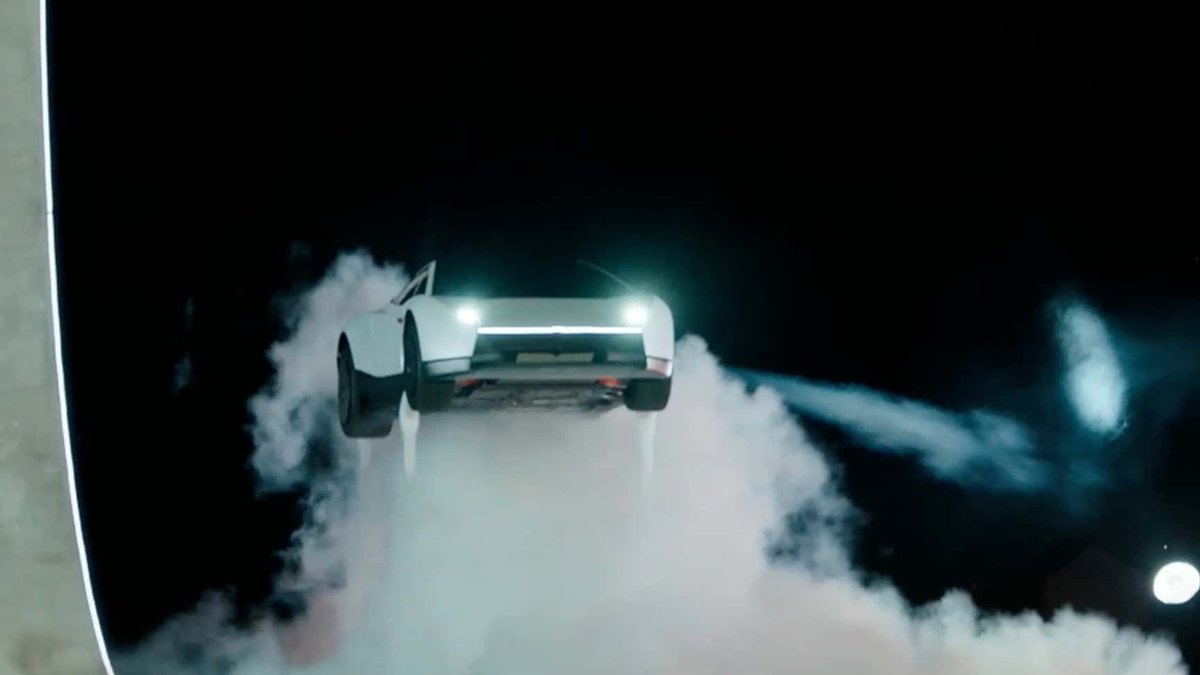
Tesla’s second-generation Roadster made its debut with a demonstration that pushed the boundaries of what an electric vehicle can do. The car, revealed at an event in McGregor, Texas, featured two standout systems: cold gas thrusters for mid-air maneuvers and a suction system that lets it drive upside down. The company showcased both during a high-profile demo, where the Roadster flipped off a ramp, performed a barrel roll, and landed upright.
The suction system generates up to 2Gs of downforce, according to Tesla Vice President of Engineering Lars Moravy. This extreme grip allows the car to corner at forces far beyond current supercars. The thrusters, meanwhile, use 10 nozzles and 250 kg of compressed gas to enable aerial stunts, including hopping over other vehicles and executing rolls. Elon Musk noted the system can refill its own tanks, though he acknowledged the demo carried risks.
“It’ll probably work,” Musk said before the demonstration, adding that success wasn’t guaranteed. The thrusters let the Roadster achieve a 0-60 mph time of 0.81 seconds, with Musk claiming the production model will beat that. The top speed exceeds 230 mph, though the long-term goal is to reach 383 mph—roughly half the speed of sound.
The Roadster will come in three versions: Performance, which includes the suction fan; Thrust, a limited-edition model with the full thruster setup; and Rocket, an “invite-only” trim with the most advanced aerobatics. All require a $50,000 refundable deposit. The Thrust and Rocket versions will be the only ones capable of the mid-air stunts shown in the demo.
The Roadster’s development has been marked by delays. First teased in 2017 as a 2020 model, it has faced skepticism over whether Tesla would ever deliver. Musk now says production will begin in 2028, though pricing, range, and legal restrictions remain unclear. The suction and thruster systems may not be street-legal in all regions, and regulators are unlikely to approve high-speed gas emissions or airborne maneuvers.