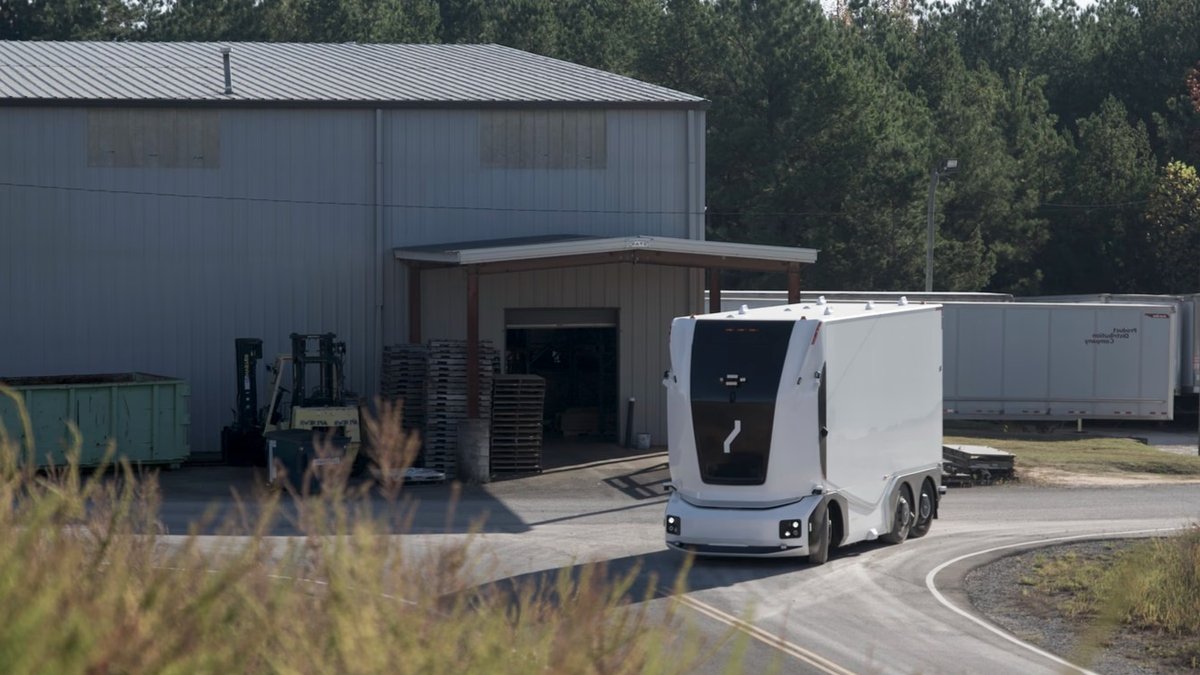
Swedish logistics firm Einride is extending its partnership with Nvidia to advance the development of autonomous electric trucks built on the Nvidia Hyperion platform.
The partnership between the two companies began in 2020, when Einride announced plans to use the Nvidia Drive AGX Orin computing platform for the next generation of its autonomous electric trucks.
From restricted areas to broader applications
Einride initially aimed to utilize the Orin system-on-chip for onboard computing power, enabling its prototype, the “Pod”, to transition from restricted areas to autonomous driving on rural roads and motorways.
The company now intends to adopt Nvidia’s technology as a complete reference architecture for Level 4 autonomy. The Nvidia Hyperion platform includes computing hardware, sensor technology, software, and safety architecture.
Einride retains full control over developing its autonomous driving technology, known as the Einride Driver. The company designs, builds, and operates the system, including safety validation and regulatory approval.
Nvidia provides the underlying computing platform and AI development tools. Henrik Green, Einride’s Chief Technology Officer, stated that building the next generation of the Einride Driver on the Nvidia Hyperion platform will enable the company to scale autonomous deployment across its freight network.
Accelerating development and validation
Rishi Dhall, Vice President of Automotive at Nvidia, highlighted the potential of autonomous trucking to improve safety and efficiency in global freight. By leveraging the Nvidia Hyperion platform, Einride can accelerate development and validation of its technology.
Einride currently operates hundreds of electric trucks for major companies in the USA, Europe, and the Middle East, including autonomous trucks deployed under customer contracts. The company expects its fleet to grow to between 1,500 and 2,000 vehicles by 2028, based on existing customer demand.
To achieve this growth, Einride recently ordered 500 Tesla Semi trucks. The company estimates that around 80% of customer demand is suitable for automation in the medium term.
Einride has also developed two autonomous electric truck prototypes in-house, which are being tested in collaboration with Lidl near Kassel. One prototype covers a 400-meter route between a logistics center and a store, with plans to expand the trial to serve multiple stores.
Einride’s strategy involves initially using conventional electric trucks and its Einride Saga AI platform to build a customer base and gather operational data. Once specific use cases for autonomous operations are established, the company plans to scale its autonomous capacity beyond the existing customer base, ultimately offering automated transport at a lower cost per shipment.