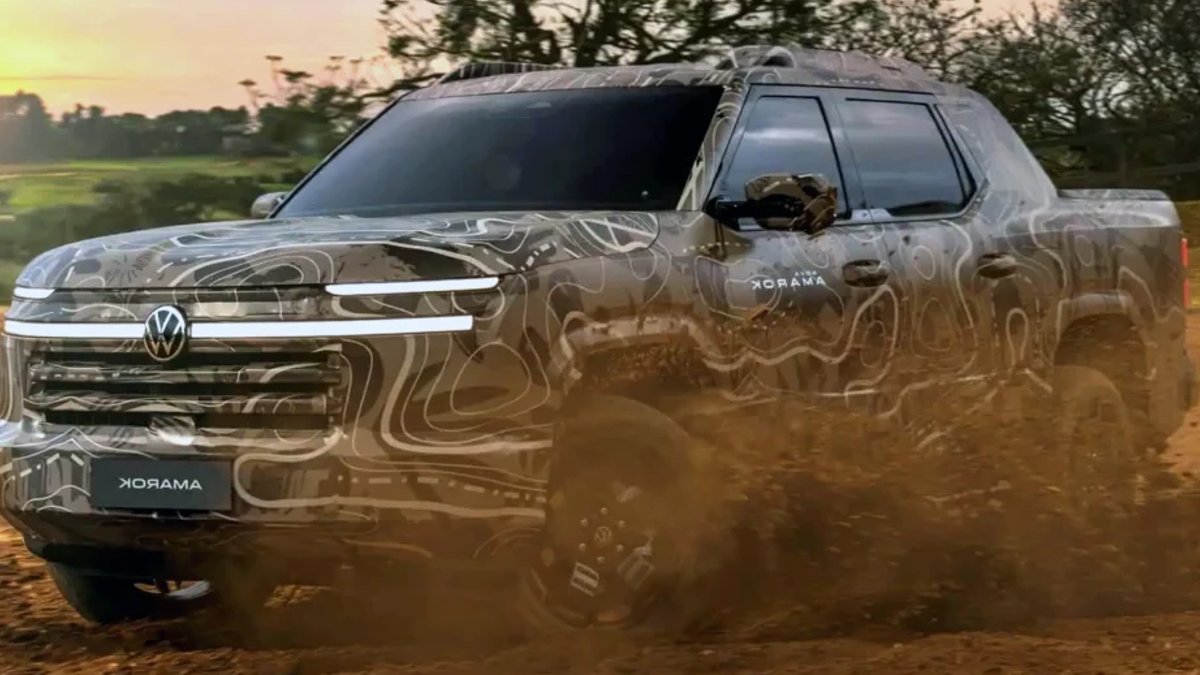
Volkswagen’s next-generation Amarok is heading to South America in 2027, and it won’t share a single component with the global version that’s built on Ford Ranger bones. Instead, the new truck is expected to borrow its underpinnings from Chinese partner SAIC, with a plug-in hybrid variant that could push output past 470 horsepower.
The automaker teased the camouflaged pickup right after unveiling the smaller Tukan for South America over the weekend. This new Amarok is built to take on the Toyota Hilux, Ford Ranger, and Mitsubishi Triton, but it will have little in common with any Amarok that came before it.
A Tale of Two Amaroks
Production will move to VW’s General Pacheco plant in Argentina, which already builds the current truck, according to reporters. This generation is believed to be reserved for South America, with a handful of other markets possible. Volkswagen has been working on it for at least a couple of years, and while the company still hasn’t confirmed the details, the truck is thought to come out of VW’s long-running partnership with SAIC, possibly sharing hardware with the Maxus Interstellar X.
Related: Stolen 1971 Chevelle SS returned after 33 years
Borrowing someone else’s engineering is a common practice in the mid-size pickup segment these days. The Nissan Navara and Mitsubishi Triton have done it, and VW already went that way with the global-spec, second-generation Amarok, which has been based on the Ford Ranger since 2022.
South America took a different route, though. VW never retired the first-generation truck there, keeping the 2010 original in production on its own older ladder-frame platform and handing it a second facelift in 2024. That leaves the two current Amaroks sharing a badge and nothing else — one built on Ford hardware, the other on a design Europe stopped buying in 2020.
Images of South America’s next Amarok confirm it will look quite a lot different than the outgoing model. The front end is all-new, sporting a full-width LED light bar and two additional DRLs positioned just before the hood shut line. Below sits a shallow grille split by two horizontal slats. Viewed from the side, we can see square wing mirror caps, squared wheel arches, chunky door handles, angular windows, and prominent roof rails. These images don’t show the new Amarok from the rear, but it too will be very different from the existing model.
Related: BYD challenges Land Rover with new seven‑seat 4×4
Chinese Underpinnings?
The new Amarok is understood to share its bones with SAIC’s Maxus Interstellar X, sold as the LDV Terron 9 outside China, Australia included. Judging dimensions from camouflaged photos is always guesswork, but for what it’s worth, the VW looks neither as wide nor as long as the Maxus. For reference, the Interstellar X measures roughly 5.50 meters (216.5 inches) long and 2.01 meters (79.1 inches) wide, riding on a 3.30-meter (129.9-inch) wheelbase. The current Amarok stretches 5.35 meters (210.6 inches) with 3.10 meters (122.0 inches) between the axles.
It’s an unusual situation for a brand that has long marketed itself on German engineering, but the mid-size truck segment has been drifting toward shared platforms for years. The previous Amarok’s collaboration with Ford raised eyebrows when it was announced, and this SAIC tie-up follows the same logic: development costs are enormous, and regional volumes don’t justify a clean-sheet design. The difference is that VW’s earlier partnership involved a Western automaker with comparable brand equity, whereas SAIC’s Maxus brand is barely known outside China and a few export markets.
A 470-HP Plug-In Hybrid Up Top
Full powertrain details remain unannounced. VW has confirmed the next generation will be electrified and the most powerful Amarok to date. Motor1 Brazil reports that a range-topping version called the 800 TSI could use a plug-in hybrid setup making more than 470 hp and 590 lb-ft (800 Nm) of torque, enough to reach 100 km/h (62 mph) in under five seconds. All-wheel drive is expected on that model.
Related: Lotus fan collects 14 rare Europa models
A turbo-diesel should stick around too, since the Maxus Interstellar X already sells one with a 2.5-liter oil-burner. That engine would slot neatly into the Amarok’s lineup for markets where diesel remains the default choice for pickup buyers, particularly in rural areas of South America where fuel infrastructure is less developed.
The current Amarok’s 3.0-liter V6 diesel produces up to 258 hp depending on the market, so the jump to 470 hp represents a significant leap for the nameplate. VW hasn’t said whether the plug-in hybrid will be available across the range or limited to the top trim, though the 800 TSI designation suggests a flagship positioning.
The timing puts the new Amarok’s arrival roughly two years after the current model received its second facelift in South America. The company has kept the old platform alive there largely because it still sells in respectable numbers, and the switch to SAIC-based hardware will finally bring the region in line with modern emissions and safety standards. Whether buyers care about the badge engineering remains to be seen — the Ford-based global Amarok has sold well enough, and the SAIC partnership offers similar economies of scale without the awkwardness of sharing a showroom with a direct competitor.