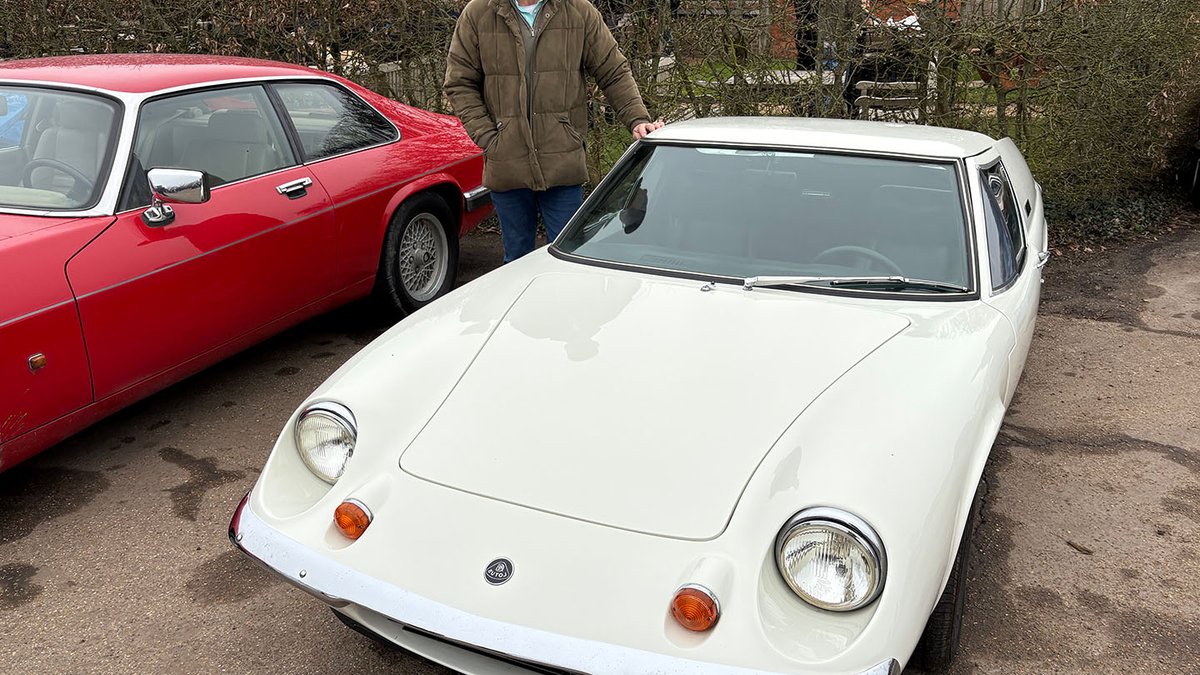
John Rand has owned 14 Lotus Europas over the years.
“My parents wouldn’t buy one for me, so I bought my own for my 21st birthday in 1975,” he recalled. “They were right to refuse because I crashed it the next day. I hit a telegraph pole and had to learn fibreglass repair since I couldn’t afford a mechanic.”
The crash that started a collection
The accident shaped his approach. Rather than risking another pristine car, he began searching for damaged Europas to restore. Over time, he raced one, rebuilt others, and became well-known among Lotus enthusiasts.
Now, he keeps two. One is a 1969 S2, a low-slung coupe with a Renault 1600 crossflow engine. The other is a lightweight Type 47, built for the track and producing 250 horsepower. “That one’s fast,” he said. “But the S2, at just 700kg, isn’t slow either.”
The S2 was restored in 1979 by a former GT40 chassis builder at Brooklands. The work included replacing the original 1470cc Renault engine with a more powerful version. “It’s run perfectly ever since,” Rand said.
A 57-year-old car that still draws attention
The Europa’s design divides opinions. Some appreciate its mid-engine layout and dramatic buttresses, while others find it odd. At 42.5 inches tall, it’s barely higher than a GT40, and the cabin is tight. “Anyone over 5-foot-10 will struggle,” Rand said. “It’s snug in winter but gets warm in summer.”
Related: Electric car speed records stall
The interior, still original, remains in great shape. Electric windows, thick carpet, and a polished wooden dashboard give it a surprisingly modern touch. The fibreglass body sits on a steel backbone chassis, a design Lotus used to reduce weight while keeping strength.
Rand’s S2 has only a few thousand miles since he bought it. “It only comes out for short drives,” he said. Valued at £20,000 to £25,000, it isn’t for sale. “I’m keeping it.”
Most owners keep one classic car for life. For Rand, it became an obsession—each Europa had its own story, its own challenges. The car taught him persistence, how to fix mistakes, and how to find value in imperfections.
Upkeep involves more than just engine care. Rand warns that the rear transmission needs monitoring—if it loosens, the car can handle unpredictably. “I doubt he’d ever let that happen,” the piece noted.
He avoids long trips. Most drives are short weekend outings, where the car’s low profile and sharp steering make every turn feel precise. The Europa was never meant to be practical. It was built to be driven, admired, and for some, collected in multiples.