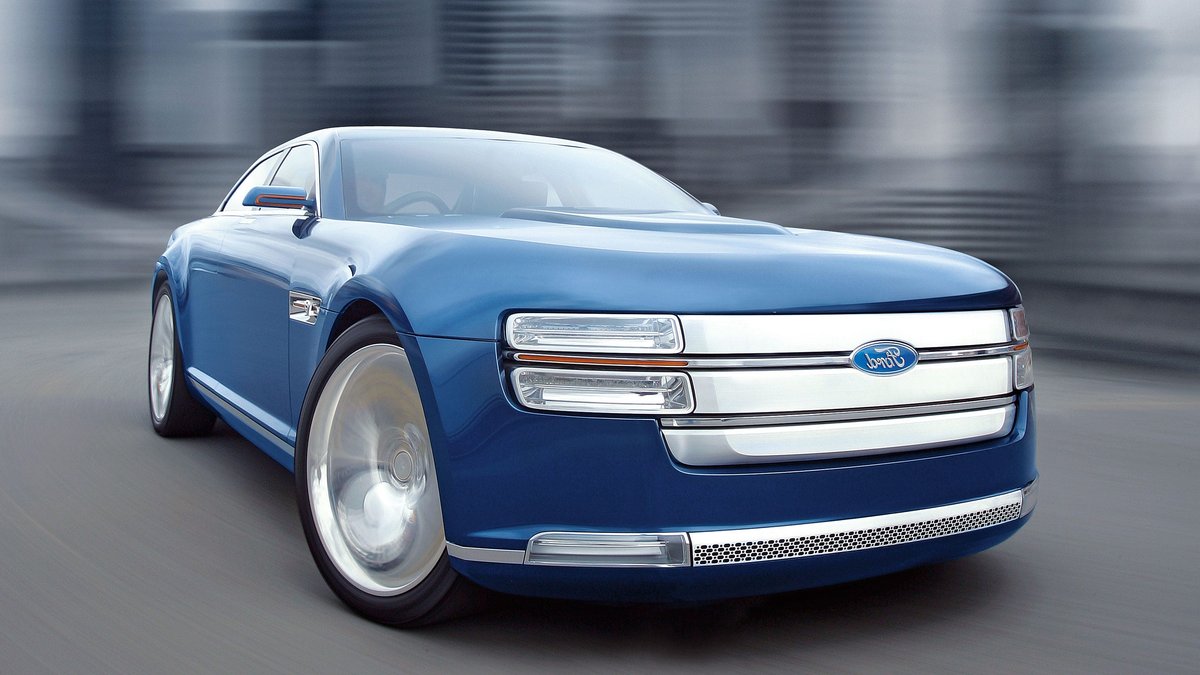
Engaging the chrome door handle with an electric push triggers the door to swing open effortlessly. The single-piece leather seats are rigid, almost as unyielding as the vehicle’s suspension, offering seating comfort akin to settling into a Barcelona chair. Directly ahead, a modern “shaker” hood scoop dominates the view, while the rest of the hood stretches long and upright.
The expanse of sheet metal beneath resembles what you’d find under a Chrysler 300. Pressing the ignition button near the headliner ignites the 5.4-liter V-8, which responds with a deep, resonant growl.
Driving the vehicle feels manageable—provided you favor low-slung vehicles. It glides over the test road with the exaggerated motion of a pastel 1964 Impala, its hydraulics amplifying every imperfection in the pavement. A single uneven patch might send it airborne.
Shifting into second gear operates flawlessly, but that’s the extent of its gearbox engagement for the day.
Interceptor: Ford’s Hidden Strategy
The Interceptor appears to be just another Ford concept car, a visually striking showcase meant to distract from the grim reality unfolding in Dearborn: plummeting sales, mounting losses, and a workforce demoralized by uncertainty. Yet behind the scenes, company leaders are finalizing a radical overhaul of how FoMoCo designs and manufactures its vehicles. The Interceptor serves as a glimpse into that transformation.
Two elements make the Interceptor significant: its aesthetic and its road manners—particularly the latter. Ford aims to introduce a completely new rear-wheel-drive sedan for North America by 2011 or 2012.
Not long ago, rear-wheel drive at Ford was nearly obsolete. The company had discontinued the underperforming Lincoln LS sedan and Ford Thunderbird, both built on the costly DEW98 platform shared with the Jaguar S-Type, and had announced the shutdown of the plants producing the Lincoln Town Car, Mercury Grand Marquis, and Ford Crown Victoria by 2010.
Reevaluating Rear-Wheel Drive
Under the leadership of CEO Alan Mulally, Ford is now reconsidering its stance on rear-wheel-drive vehicles for the North American market. Insiders report Mulally studied how GM revitalized Cadillac and the enthusiasm surrounding new rear-wheel-drive models like the Chevy Camaro, Pontiac G8, and the China-market Buick Park Avenue—all built on the Australian-derived Zeta architecture. Mulally asked: “Insiders say Mulally has looked at what GM has done to reinvent Cadillac, seen the buzz it’s generated around new rear-drive cars like the Chevy Camaro, Pontiac G8, and the Chinese-market Buick Park Avenue.”
Meanwhile, in Australia, the Falcon, Ford’s rear-wheel-drive competitor to GM’s Holden Commodore, is receiving a major redesign for 2008, though its underpinnings trace back to 1998.
Neither vehicle’s production volume, 160,000 Mustangs and 50,000 Falcons and variants in 2006, justifies developing separate next-generation platforms.
The Interceptor embodies this vision. By 2010, the aging Panther platform supporting the Crown Victoria, Grand Marquis, and Town Car will have been in use for 31 years, longer than even the iconic Model T remained in production (19 years). Though these vehicles remain profitable, their outdated designs and limited appeal to private buyers rely almost entirely on fleet sales, taxis, police departments, and commercial fleets, which declined by 10 percent in 2006 compared to the prior year.
Incorporating replacements for the Panther trio into the equation significantly boosts production scale.
As of now, Ford engineers are racing against a July deadline set by Mulally. The global rear-wheel-drive architecture is just one component of a sweeping restructuring of Ford’s entire product development approach. The stakes could not be higher: With $23.4 billion in loans secured to fund essential new models, Mulally’s team is gambling everything on this strategy’s success.
Designing the Future
The Interceptor, though never officially called that during development, emerged from a collaborative effort between Ford’s North American design team. The digital model was crafted by Andreas Nilsson in Dearborn, while the full-scale clay was shaped in California under the guidance of Freeman Thomas, the designer behind legends like the VW Beetle, Audi TT, and Chrysler 300C.
“Galaxie was the name we used in the studio when we were working on this,” says Horbury. A closer look at the taillights confirms the influence: they evoke the ’66 Galaxie.
The Interceptor isn’t a throwback, but its design draws from the hallmarks of classic American sedans that defined an era. “A lot of cars have lines that swoop upward and backward,” says Horbury with a sweep of a hand. Horbury explains, “On Woodward Avenue in August [in the Dream Cruise] you see these fabulous ’50s and ’60s American cars, and they all have that graceful line that flows down toward the rear, rather like a yacht sailing by.”
Examining the Interceptor closely reveals this philosophy: despite a slight wedge in the beltline, the roofline descends gracefully toward the rear. The design is subtly sophisticated, except for the bold front end, which directly references the Super Chief pickup concept Horbury unveiled at the 2006 Detroit Auto Show.
“It’s a statement to say this is the Super Chief of cars,” says Horbury.
Full-size sedans will never regain the mass-market dominance they held in the 1950s and 1960s. Today, that role belongs to compact and midsize front-wheel-drive models like the Toyota Camry, Honda Accord, Chevy Malibu, and Ford Fusion. President George W. Bush’s push to achieve 35 mpg under CAFE standards by 2017 further threatens their viability, though European automakers have already demonstrated that a big car can achieve 30 mpg or better with a high-torque diesel V-6 or V-8 engine.
Yet the positive reception to vehicles like the Chrysler 300C, Pontiac G8, and China-market Buick Park Avenue proves that many Americans still crave a spacious, stylish, and affordable rear-wheel-drive sedan. These cars evoke the quintessential American driving experience, a tradition lost when domestic automakers downsized and shifted to front-wheel drive in the 1980s, leaving personal-use pickup trucks to dominate.
The plea goes: “Build the Interceptor, Alan. Name it the Galaxie. Develop a premium Mercury variant and a Lincoln flagship. Prioritize fuel efficiency, hybrids or diesels if necessary, but bring these cars to market.”
Ford’s Global Rear-Wheel-Drive Strategy
Ford is exploring a unified global architecture for its rear-wheel-drive vehicles, aiming to streamline production and reduce costs. The plan includes leveraging the Australian Falcon platform, which offers flexibility in wheelbase and width, enabling variations such as a smaller Crown Victoria replacement and larger vehicles like the Lincoln flagship.
The strategy also addresses all-wheel-drive (AWD) applications, ensuring compatibility for markets requiring such systems, including snowbelt states in the U.S. Ford Australia’s Territory, an AWD crossover built on the Falcon platform, serves as a model for this integration. Additionally, the global architecture would allow Ford to export U.S.-built rear-drive cars to markets like China, the Middle East, and Brazil, competing with GM’s Australian-built Commodore and Statesman-based vehicles.
While Ford Australia may discontinue the long-wheelbase Fairlane/LTD due to weak sales, the global platform could facilitate importing a rival model, such as a Lincoln-based vehicle, either as a complete unit or assembled locally from Detroit-supplied components. This approach aligns with Ford’s goal of maximizing efficiency and market reach across its rear-wheel-drive lineup.