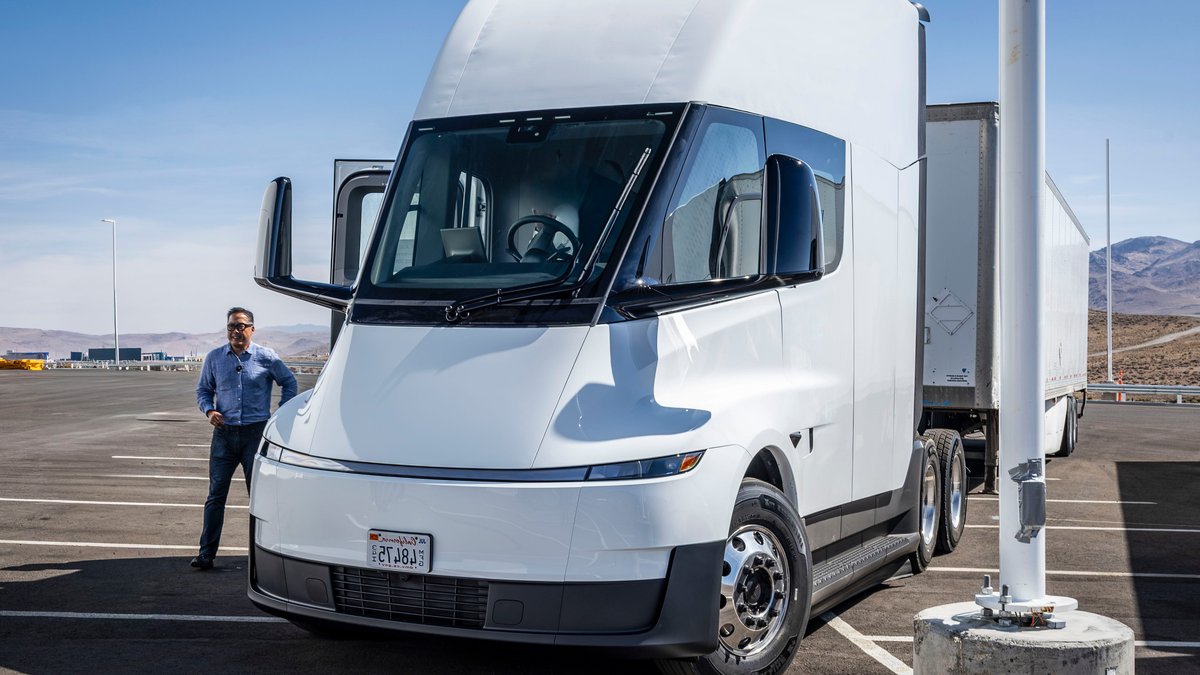
Tesla’s Semi electric truck utilizes a torque drive axle (TDA) to maximize power during hard acceleration and climbing. At steady highway speeds, the TDA disengages to reduce drag, allowing the efficiency drive axle (EDA) to take over. The production Semi uses 4680 battery cells, arranged in eight bandoliers of 28 cells per module, with 14 modules across three packs for a total of around 850 kWh, providing a 500-mile range. Tesla claims the batteries are rated for 1 million miles of use and can charge to 60% in 30 minutes.
The Semi features a 1,076 horsepower motor and a skateboard chassis, forming a robust heavy-duty platform. During the “Semi Rollout” launch event, a live feed showed a Semi charging at close to its 1.2-megawatt (1200-kW) limit, reaching over 60% charge in approximately 40 minutes.
Road manners
Operating the Semi feels unexpectedly familiar, despite its size. Accessing the cabin via the Tesla app or a keycard reveals a spacious interior with a center-mounted driver’s seat and a jump seat behind it. The controls, borrowed from the Model 3 and Model Y, include twin 16-inch touchscreens and a manually adjustable steering wheel.
To start the Semi, the driver presses the brake pedal, shifts the gear selector into drive, and activates the parking brake release. Once in motion, the truck delivers smooth acceleration and light steering, characteristic of Tesla’s design. The high seating position and excellent visibility, enhanced by side mirrors and cameras, simplify lane centering.
The Semi’s tight turning radius is achieved through independent front suspension and an increased steering angle, enabling it to maneuver through narrow roads with ease. A U-turn on a two-lane road felt comparable to that of a Model Y.
For long-haul drivers, the suspended seat offers extensive adjustments, ensuring comfort during extended trips. The electric power steering provides a light yet precise feel, requiring about five turns lock to lock.
Tesla aims to produce 1,000 Semis weekly at its Sparks, Nevada factory, employing 3,000 workers across four shifts. A brief test drive at Tesla’s Reno Gigafactory highlighted the Semi’s combination of power, efficiency, and user-friendly design.
Battery and Charging Innovations
The production Semi integrates Tesla’s 4680 battery cells, also used in the Cybertruck. Manufactured in Austin, Texas, and Sparks, Nevada, these cells are arranged in eight bandoliers of 28 cells per module. The long-range Semi uses 14 modules across three packs, totaling around 850 kWh for a 500-mile range. The standard-range version uses two packs for 325 miles.
Cabin Design and Driving Experience
Visibility is excellent, aided by side mirrors and cameras that display blind spots on the touchscreens.