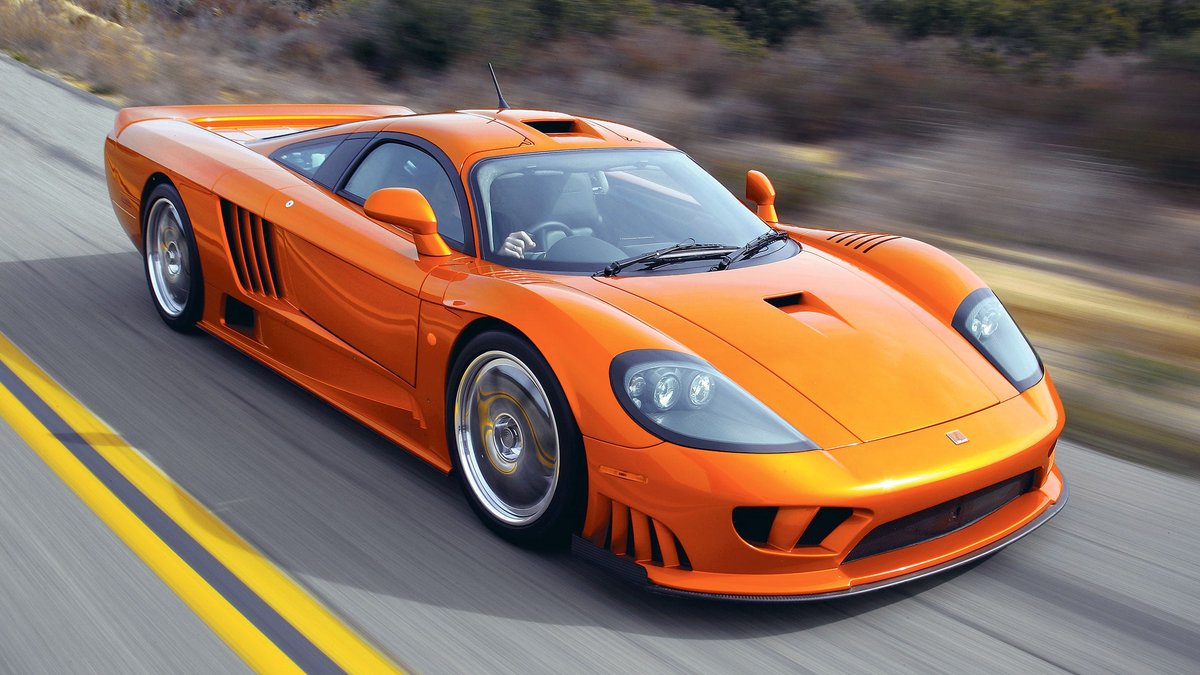
The Saleen S7 Twin Turbo, a mid-engine supercar with a 750-horsepower twin-turbo 7.0-liter V-8, debuted in 2006 as a direct challenge to European exotics like the Bugatti Veyron—and it did so with an all-American powerplant. Based on the original S7, which launched in 2003 with 550 horsepower, the Twin Turbo version increased output by 36% while maintaining a curb weight under 2,750 pounds. The car’s top speed was claimed to exceed 220 mph, and its 0-to-60-mph time was advertised at 2.8 seconds—faster than the Ferrari Enzo and nearly as quick as the Veyron’s unconfirmed figures.
The engine itself embodied contradictions: a pushrod V-8 with a single camshaft and two valves per cylinder, yet refined by NASCAR race teams and capable of producing 700 pound-feet of torque at 4,800 rpm. Weighing just 440 pounds, it was light enough to sound like a WWII fighter plane at idle, according to test driver Neil Chirico, who described its metallic snarl and unrelenting torque as more akin to a Saturn V launch than a street machine. The dry-sump, all-aluminum block traced its roots to sprint cars and stockers, where Bill Tally, Saleen’s engineering vice president, had cut his teeth before transitioning to supercars.
Performance figures for the S7 Twin Turbo surpassed those of its competitors on paper. The 2001-plated mule, later updated to Twin Turbo specifications, delivered a 3.4-second 0-to-60-mph run, 6.0 seconds to 100 mph, and a quarter-mile time of 10.7 seconds at 143.8 mph. However, these results came with limitations. The test car was a track-focused prototype, not the production model, and its fixed pedals and narrow footwell made it impractical for everyday use. Chirico noted the car’s initial understeer, a trait that vanished once speed and grip increased. Still, the numbers required 14 runs to perfect—far more than the five typically needed for a production test.
A Raw Power Experience Without Compromise
The S7 Twin Turbo wasn’t just fast; it was uncompromising. The six-speed Randolph Austin transmission whined like an old freight elevator, the power steering hissed like a steam engine, and the full-floating brakes rattled over bumps. Even at 2,000 rpm on light throttle, the drivetrain shunted violently, a side effect of Tier 2 emissions mapping and the tightly wound gearset. Tally acknowledged the trade-off: roughness for raw power. Unlike modern supercars, which could be driven through a Wal-Mart parking lot without effort, the S7 Twin Turbo demanded complete focus. It lacked traction control, anti-lock brakes, and even allowed no adjustments to the fixed steering wheel.
The interior mirrored its dual-purpose nature: functional, not indulgent. While it featured a CD sound system, a rearview TV screen, and custom air-conditioning controls, the cabin lacked the quiet luxury of a Veyron or the carbon-fiber spectacle of a Pagani Zonda. Access posed another challenge. The wide sill panel and tight-fitting seat required race-style driving shoes to avoid stomping on pedals. Buyers were offered an overnight stay at the Ritz-Carlton in Dana Point to adjust to the setup, but the fixed steering wheel remained a compromise.
Related Post: Kia EV driver hit with $16,000 power bill
Track-Ready Design with Unmatched Grip
On the road, the S7 Twin Turbo revealed its race-car heritage. The two-stage coil-spring suspension, inspired by motocross bikes, kept it planted on ultralow-profile tires, while the 15-inch front rotors and 14-inch rears delivered unmatched braking power, though without anti-lock protection. The swoopy bodywork, tested in the University of Glasgow wind tunnel, generated downforce from 40 mph. Yet the car’s unfiltered nature made it feel more like a track weapon than a grand tourer. Even a Saturday morning drive to Starbucks sounded like a hot lap.
The S7 Twin Turbo’s $580,000 price tag positioned it as a direct rival to the Bugatti Veyron, which started at $1.25 million. Though the Veyron’s 1,001-horsepower quad-turbo W-16 was unmatched in output, Saleen’s engine delivered its 700 pound-feet of torque at a more usable 4,800 rpm. The Veyron’s power arrived gradually, requiring careful throttle management to avoid wheelspin, while the Saleen unleashed its torque in a single, overwhelming burst, demanding instant precision. This characteristic, combined with the fixed pedals and narrow footwell, reinforced its identity as a track machine repurposed for the road.
Unverified Claims and Engineering Trade-Offs
Saleen’s marketing claimed the S7 Twin Turbo could exceed 250 mph, though no independent verification existed. The 2001-plated test mule, which hit 143.8 mph in the quarter-mile, was not the same car used for road testing. The production model, tested by MotorTrend, lacked the same level of tuning. Tally admitted the performance figures were aspirational, not guaranteed. Even the 2.8-second 0-to-60-mph claim, matching the Ferrari Enzo, required 14 attempts to achieve, far beyond the five runs typical for production cars.
The car’s lack of modern amenities was intentional. Unlike the Veyron, which included traction control, anti-lock brakes, and an adjustable interior, the Saleen offered none. The full-floating brakes, while capable of stopping the car from 120 mph in under 100 feet, rattled over uneven pavement. These traits weren’t flaws; they were features, reinforcing the car’s unfiltered nature. Saleen’s mission had always been to provide American alternatives to European exotics, and the Twin Turbo embodied that philosophy. It was built for drivers who valued power above all else, even if comfort took a backseat.